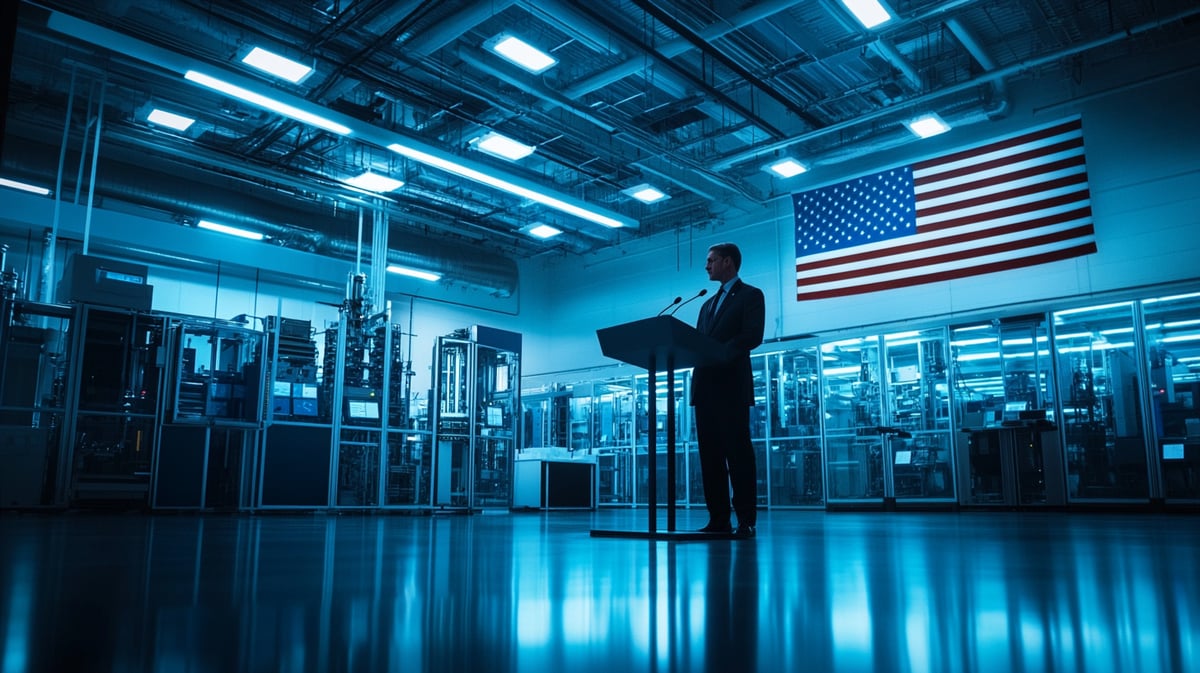
The US has formally launched the Pax Silica initiative, a new security bloc spanning critical minerals, semiconductor fabs and AI infrastructure, in a move that effectively creates an allied cartel around the hardware stack powering both large-scale AI and high-performance crypto infrastructure.
Announced at the inaugural Pax Silica Summit in Washington on December 12, the State Department describes the pact as its “flagship effort on AI and supply chain security,” covering everything from raw mineral extraction and energy inputs to chip design, fabrication, packaging, data centres, fibre networks and logistics. The alliance launched with nine core participants: the US, Japan, South Korea, Singapore, the Netherlands, the UK, Israel, the UAE and Australia.
OPEC-for-silicon architecture
The official framing goes well beyond semiconductors. In its description, the State Department commits members to coordinate on “strategic stacks” of the technology supply chain, explicitly naming software platforms, frontier AI models, connectivity and network infrastructure, compute and semiconductors, advanced manufacturing, minerals refining and processing, and energy. The language mirrors a playbook for vertical control: from lithium and rare-earth inputs up to the data centres where GPUs and accelerators are racked.
Singapore’s government called the non-binding Pax Silica Declaration a pact to build and deploy “trusted information networks,” including ICT systems, fibre cables and data centres, at the close of the Washington summit on December 12. Israel confirmed separately that it joined the initiative to cooperate on securing AI supply chains.
“Together, these countries are home to the most important companies and investors powering the global AI supply chain,” the State Department noted in its summit statement.
India on the outside, Asia reads a message
For markets, the more telling detail is who is absent. India — now central to Western chip design and a declared partner on critical minerals — is not part of the initial nine-country coalition. Indian and regional press have zeroed in on that omission. Business Standard and Indian Express both highlight that Pax Silica launched just as New Delhi has been trying to position itself as an alternative hub in post-China supply chain realignment, yet still did not make the US “trusted end-to-end” list.
Opposition politicians in India have already framed the exclusion as a reflection of Delhi’s limited traction in the advanced AI supply chain. Congress MP Jairam Ramesh called India’s absence “not very surprising,” arguing it stems from how Washington currently rates India’s capabilities in cutting-edge segments despite recent critical minerals MoUs.
For Asia-focused allocators, the signal is clear: in the White House view of AI-era supply chains, the tightest security perimeter still runs through Northeast Asia plus a small set of Western-aligned resource and capital exporters, not the broader BRICS-plus world.
Why this lands directly on crypto infrastructure
The same fabs, advanced nodes and mineral flows Pax Silica targets sit upstream of core crypto plumbing: GPU-based mining, high-frequency trading infrastructure, staking validators and DePIN-style distributed compute. This is not yet a new export-control regime, but it lays the political groundwork for one. If this bloc starts coordinating restrictions the way OPEC coordinates production, blockspace and hashpower will feel it down the stack.
Three practical channels matter for crypto operators and capital allocators:
1) GPU and accelerator supply. Nvidia, AMD and emerging accelerator vendors already face US export controls around advanced AI chips to China. Pax Silica bakes those concerns into a multilateral economic security doctrine. Any future tightening on where A/H100-class or next-gen equivalents can ship, or which cloud regions can host them, will squeeze the same inventories used by GPU miners, on-chain AI inference projects and latency-sensitive trading desks.
2) Data centre siting and cost of power. The declaration explicitly mentions compute, data centres, energy grids and power generation as coordinated priorities. 【source】 That aligns with the current boom in AI-ready campuses in the US, Japan and Korea, and it will pull more hyperscale buildout into allied jurisdictions. Centralized exchanges, large custodians and liquid staking operators that run bare metal will increasingly face a binary choice: pay up to colocate in “trusted” regions, or risk future sanctions and controls if they sit capacity in a non-aligned bloc.
3) Divergent hardware and compliance standards. By casting compute and minerals as strategic assets on par with traditional defense supply chains, the US and partners are setting the stage for two partially incompatible hardware spheres: an allied Pax Silica stack and a China/BRICS stack. Over time, miners, validators and DePIN networks may need to certify which stack they sit on to access Western capital, listings or custodial services.
Positioning for a split-compute world
The near-term market impact for listed chip names and AI-exposed equities has dominated mainstream coverage. For crypto, the timetable is slower but the direction of travel is similar to the 2022–2023 wave of export curbs on advanced GPUs to China: a policy decision at the top of the stack eventually re-prices capacity at the bottom.
DePIN and distributed-compute projects now sit in a different light. If Pax Silica members concentrate manufacturing and most “trusted” data centres, non-aligned states will have to cultivate their own chip and infra ecosystems or accept chronic rationing. Tokenized compute and storage networks that can straddle both worlds without touching sensitive nodes start to look less like speculative experiments and more like policy hedges.
On the flip side, Pax Silica’s focus on “trusted information networks” and secure infrastructure points toward tighter scrutiny of cross-border connectivity, submarine cables and data flows. Centralized exchanges routing order flow through data centres in non-allied hubs, or mining operations anchored in those locations, move higher on the regulatory radar.
For institutional desks, the message in December 2025 is not about this week’s GPU prices. It is that a formal US-led alliance now treats compute capacity, chips and the mineral stack beneath them as long-horizon strategic commodities. Any strategy that assumes fungible, apolitical access to high-end silicon over a five- to ten-year horizon now carries regime risk that needs to be priced alongside protocol and regulatory risk.